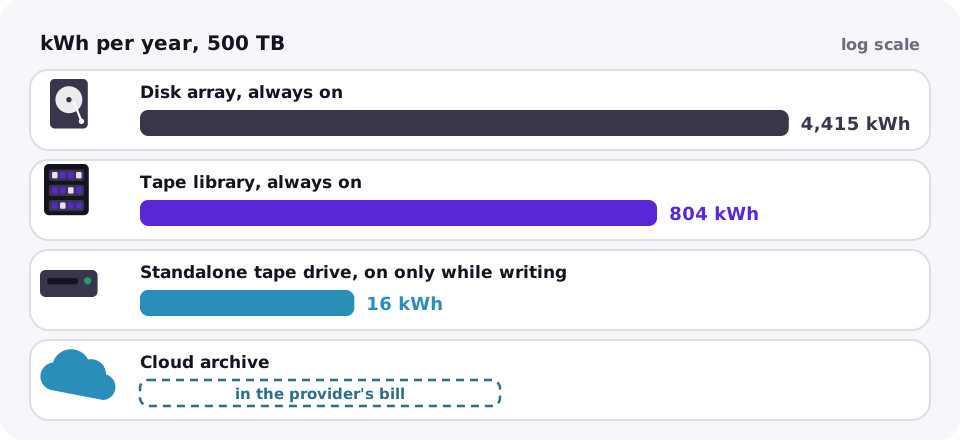
A standalone LTO drive that is switched on only while it writes is the most energy-efficient way to keep an archive: a cartridge on a shelf uses no power at all. In our 500 TB model, a disk array kept online uses about 4,400 kWh a year, a small tape library left on all year about 800 kWh, and a standalone drive used only for writing about 16 kWh.
Energy figures depend on your hardware, so below are the assumptions behind each number. Swap in the values from your own data sheets to redo the sums.
How the options compare on energy
| Option | Assumption | kWh per year |
|---|---|---|
| Disk array, always on | 32 hard drives of 20 TB (500 TB plus parity and spares) at about 7 W each, plus 50% for enclosure and controllers, plus 50% for cooling | About 4,415 |
| Tape library, always on | About 60 W idle for a small library with its drive, plus 50% for cooling, plus the writing below | About 804 |
| Standalone tape drive, on only while writing | One full 500 TB write a year at 400 MB/s (about 347 hours) at about 30 W, plus 50% for cooling | About 16 |
| Cloud archive | Energy is part of the provider's price | Not billed separately |
Operating cost per year
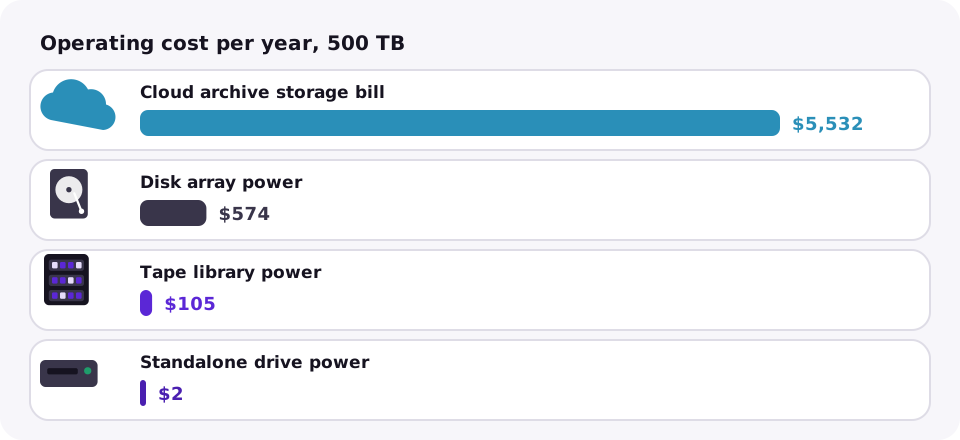
At $0.13 per kWh, close to the US commercial average, the power bill is small for tape and noticeable for disk. For cloud archive storage, the monthly bill is the operating cost.
| Option, 500 TB | Operating cost per year | What drives it |
|---|---|---|
| Cloud archive (Glacier Deep Archive) | About $5,532 | Storage billed every month; restores billed on top |
| Disk array power | About $574 | Drives, enclosures and cooling running all year; drives replaced every few years |
| Tape library power | About $105 | Library idle draw plus writing |
| Standalone tape drive power | About $2 | Only the hours spent writing |
Other operating costs to plan for
Power is only part of the picture. Disk arrays need drives replaced every three to seven years. Tape needs cleaning cartridges, offsite storage for the second copy, a periodic read check and a migration to newer media every two or three drive generations. Cloud adds retrieval and egress fees whenever you read data back.
The full five-year comparison, including hardware, is in tape backup 5-year TCO, and drive choices in the LTO drive buyer's guide.
Frequently asked questions
Does tape use power when it is stored?
No. A cartridge on a shelf uses no electricity. Only the drive or library uses power, and only while it is switched on.
Is a tape library worth its extra power?
Usually yes if jobs span several cartridges or run unattended. A small library adds tens of watts of idle draw, which costs roughly $100 a year in our model.
How can I cut tape energy further?
Power down standalone drives between jobs, eject cartridges to the shelf, and schedule large writes together so the drive streams without stopping.
Is cloud storage more energy efficient than tape?
You cannot measure it directly: the energy is inside the provider's price and data centre. For cold data, tape on a shelf uses less energy than any always-on system.