Learn About LTO Tape Drives
Comprehensive guide to Linear Tape-Open technology, drive generations, specifications, and benefits
LTO vs HDD: Which Is Better for Long-Term Storage?
Compare LTO tape vs hard drive for backup — durability, cost, ransomware protection, and real-world use cases
Cost Efficiency Over Time
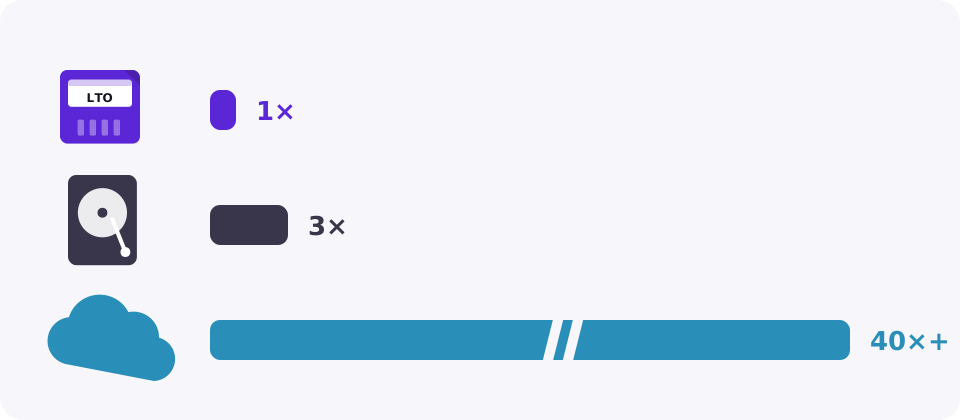
LTO tape offers the lowest total cost of ownership (TCO) for long-term data storage. While initial hardware investment is required, the ongoing costs are minimal.
| Storage | Cost | Unit | What drives the cost |
|---|
| LTO Tape | $5 to $7 | per TB | One-time media cost, zero power costs when stored |
| Disk Storage | $15 to $30 | per TB | Hardware depreciation, ongoing power and cooling |
| Cloud Storage | $20 to $50+ | per TB/year | Recurring monthly fees plus egress charges |
Long-term Savings Example:
For 1 PB stored over 10 years: Tape = ~$75,000 | Disk = ~$300,000 | Cloud = ~$2,000,000+
Longevity and Stability
LTO tape cartridges are designed for 30+ year archival life when stored properly in controlled environments. This makes tape ideal for compliance and regulatory requirements.
Media Stability
• No mechanical wear when stored
• Stable magnetic properties
• Resistant to bit rot
• Self-contained and portable
Comparison
| Storage | Typical lifespan |
|---|
| Hard drives | 3-5 year lifespan |
| SSDs | 5-10 year retention |
| Tape | 30+ year archival life |
| Cloud | Dependent on provider |
Air Gap and Ransomware Protection
The ultimate defense against cyber threats
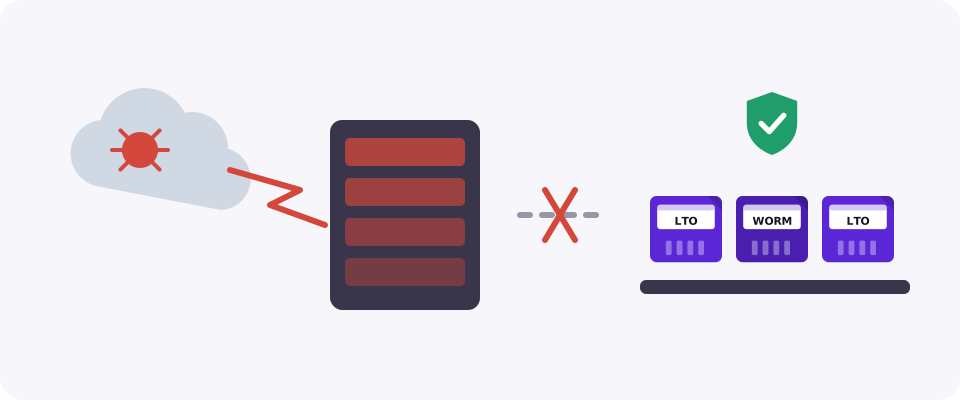
Tape provides a physical air gap - when ejected from the drive and stored offline, tape cartridges are completely isolated from networks and cannot be accessed, modified, or encrypted by malware.
The 3-2-1-1-0 Backup Rule
| Number | Rule |
|---|
| 3 | copies of your data |
| 2 | different media types |
| 1 | copy offsite |
| 1 | copy offline (air-gapped) ← This is where tape excels |
| 0 | errors after verification |
Protection and security
| Protection against | Additional security |
|---|
| Ransomware encryption | Hardware AES-256 encryption |
| Malware propagation | WORM (Write-Once-Read-Many) |
| Insider threats | Physical custody control |
| Network-based attacks | No internet dependency |
Energy Efficiency
Unlike disk or cloud storage that requires continuous power, tape consumes zero energy when stored. This makes it the most environmentally sustainable storage option.
| Storage | Power | Note |
|---|
| Tape Storage | 0 W | Zero power when offline |
| Disk Arrays | ~10 W | per TB continuously |
| Cloud Storage | Variable | Datacenter overhead |
For organizations storing petabytes, the energy savings translate to significant cost reductions and reduced carbon footprint.
Hybrid Backup Strategy
Tape works best as part of a comprehensive backup architecture
Modern organizations use a tiered approach combining multiple storage types to optimize for performance, cost, and security.
| Tier | Storage | Role |
|---|
| 1 | Disk (Primary Backup) | Fast recovery for recent data, immediate restore capability, typically 30-90 days retention |
| 2 | Cloud (Offsite Replication) | Geographic redundancy, disaster recovery scenarios, automated replication |
| 3 | Tape (Long-term Archive + Air Gap) | Cost-effective retention, compliance archives, ransomware-proof offline copies |
Best Practice:
Use disk for rapid restores, cloud for disaster recovery, and tape for long-term retention and ultimate protection. This hybrid approach delivers the best of all worlds.