How long do LTO tapes last?
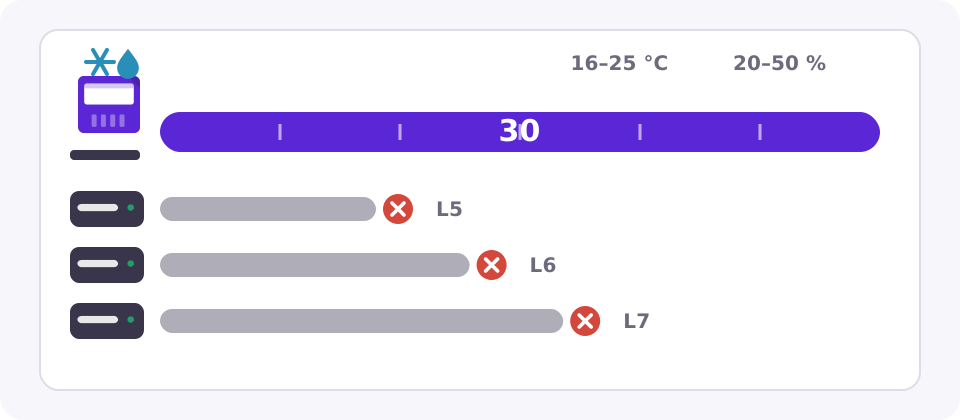
Manufacturers rate them for 30 years of archival storage at 16 to 25 °C and 20 to 50% relative humidity. Drive availability usually ends earlier, so migrate every two or three generations.
Lifespan guide
LTO cartridges are rated for 30 years of archival storage at 16 to 25 °C and 20 to 50% humidity, but the practical limit is usually the drives: LTO-8 and newer read only one generation back, so plan to migrate every two or three generations.
The 30-year figure
Fujifilm, Sony and the drive vendors rate LTO cartridges for 30 years of archival storage. The figure comes from accelerated ageing tests of the magnetic coating and base film, and it assumes the cartridge is stored in controlled conditions and handled correctly. A cartridge kept in a hot car or a damp basement will not last that long.
Storage conditions
Cases, cabinets, racks and offsite rotation are covered in how to store LTO tapes.
Wear
A cartridge is rated for many thousands of loads; LTO-9 media is rated for 20,000 load and unload cycles. An archive tape that is written once and read occasionally will never get near that. Tapes used for daily backups wear faster, which is one reason to rotate them and replace them on a schedule.
The real limit
The tape usually outlives the drives that can read it. LTO-8 and newer drives read only one generation back, and new drives for older generations disappear within a few years. A perfectly preserved LTO-5 tape is useless without a working LTO-5, LTO-6 or LTO-7 drive.
So the practical lifespan of an archive is set by your migration plan: copy to current media every two or three generations, and keep at least one working drive for every generation still on your shelves. See LTO tape migration.
Compared
Hard drives are usually replaced after 4 to 6 years in service, and a drive left unpowered on a shelf for years is not designed for archival storage. Tape is designed to sit unpowered. See LTO vs HDD.
Check
Read a sample of cartridges back every year or two and compare checksums. Backup software can verify tapes on a schedule. It is the only way to know the archive is still readable before you need it.
More guides
Pricebook
Request current LTO media and drive pricing before you budget a migration or a refresh.
Manufacturers rate them for 30 years of archival storage at 16 to 25 °C and 20 to 50% relative humidity. Drive availability usually ends earlier, so migrate every two or three generations.
30 years in archival conditions, and the cartridge is rated for 20,000 load and unload cycles.
Slowly, and much more slowly than a hard drive left unpowered, as long as it is stored cool, dry and stable. Read samples back periodically to check.
No routine re-tensioning is needed for LTO. Store cartridges properly and let the drive handle tension when it reads them.