Migrate an LTO archive before the drives that can read it disappear: LTO-9 drives read only LTO-9 and LTO-8, and LTO-10 drives read nothing older, so every generation you skip narrows the window for reading the old tapes.
When to migrate
Signs it is time to move an archive to newer media
Your drive generation is going out of the market. New LTO-6 drives are effectively gone and several LTO-7 models now show call for availability. When a drive dies and cannot be replaced, the tapes it wrote become a recovery project.
The compatibility window has closed. LTO-8 and LTO-9 drives read only one generation back (LTO-9 reads LTO-8), drives up to LTO-7 read two back, and LTO-10 drives read only LTO-10. An LTO-5 tape needs an LTO-5, LTO-6 or LTO-7 drive; nothing newer will mount it.
Cartridge count is the real cost. 500 TB on LTO-5 is 334 cartridges to store, label, handle and eventually read back. The same archive is 28 LTO-9 cartridges.
You cannot prove the archive is readable. If nothing has been restored from those tapes in years, a migration is also the verification pass you have been postponing.
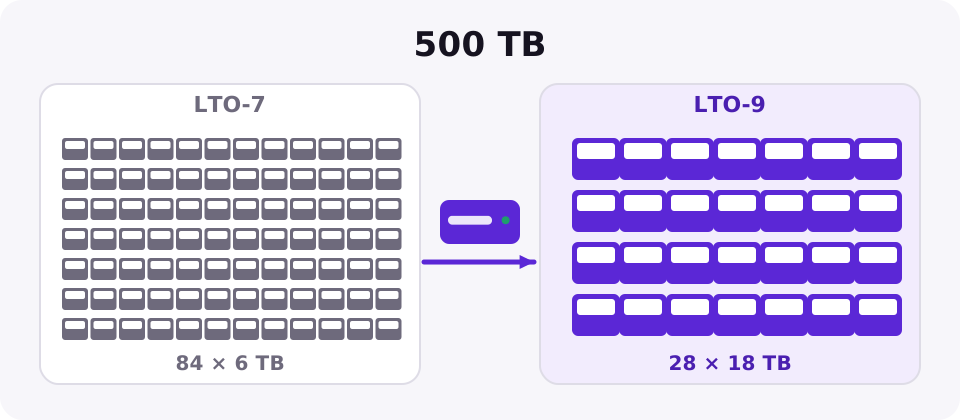
The same 500 TB needs 84 LTO-7 cartridges but only 28 LTO-9 cartridges, so a migration also shrinks what you store, label and handle.
Cost and time
What migrating 500 TB actually costs
Media cost is the easy part to budget: divide the archive by the native capacity of the target generation and multiply by the cartridge price. As of 23 October 2026, LTO-9 media costs $92.45 to $129.00 per 18 TB cartridge ($5.14 to $7.17 per TB), and a new internal LTO-9 drive runs $8,009 to $13,329.
Source archive
Cartridges today
On LTO-9
New media cost
Read plus write time
LTO-5 (1.5 TB)
334 cartridges
28 LTO-9 cartridges
$2,589 to $3,612
56 days on one drive pair
LTO-6 (2.5 TB)
200 cartridges
28 LTO-9 cartridges
$2,589 to $3,612
51 days on one drive pair
LTO-7 (6 TB)
84 cartridges
28 LTO-9 cartridges
$2,589 to $3,612
34 days on one drive pair
The time column adds reading at the source generation's rated speed (LTO-5 up to 140 MB/s, LTO-6 160 MB/s, LTO-7 300 MB/s) to writing at LTO-9's 400 MB/s, running flat out with no stoppages. The old drive is usually the bottleneck, which is why the LTO-5 row takes about two thirds longer than the LTO-7 row for the same 500 TB. Run the read and the write on separate drives in parallel and you approach the slower of the two figures rather than their sum.
Budget for the things that are not media: a SAS HBA per drive, a server with enough disk to stage data if you are not copying tape to tape, backup software or LTFS tooling, and staff time to load cartridges unless you have a library.
How to do it
A migration plan that does not lose data
Inventory first. List every cartridge, its generation, its label and what your catalogue says is on it. Cartridges whose contents nobody can identify are the ones that turn a migration into an archaeology project.
Decide the target generation. LTO-9 is the cheapest per terabyte and its drives still read LTO-8. LTO-10 halves the cartridge count again but costs more per terabyte and reads nothing older, so it suits a fresh archive better than a migration.
Keep the old drive until the end. Do not decommission the only drive that can read your source media until the new copy is verified, and keep one working drive for the old generation afterwards if any tapes stay behind.
Copy, then verify by reading back. Checksums written at copy time only prove what the buffer held. Read the new cartridges back and compare hashes against the source before you retire anything.
Migrate the catalogue too. A perfect copy with no index is an unsearchable pile. Whether you use backup software or LTFS, make sure the new tapes are recorded where restores will actually look.
Keep two copies during the move. The window where an archive exists only on cartridges that are being rewritten is the riskiest moment in its life.
Tape to tape or via disk
Two ways to move the data
Tape to tape needs two drives on one host and copies without a staging area. It is the simplest path when both generations are in the same library or on the same SAS bus, and it keeps the data under one tool's control the whole way.
Through disk stages the source on a disk pool first, then writes the new cartridges. It is slower and needs the space, but it lets you deduplicate, re-catalogue, or repack many part-full old cartridges into full new ones, and it decouples a slow old drive from a fast new one.
Repacking matters more than it looks: an archive written years ago in small jobs often leaves cartridges half full, so the real cartridge count can be well above the raw capacity maths.
Outsourcing
When to hand a migration to a service
A service makes sense when nobody still has a working drive for the source generation, when the archive is large enough that months of drive time would block other work, or when a data centre move or shutdown puts a date on it. Ask any provider three things: how they verify each cartridge after writing, whether the chain of custody is documented for media leaving your site, and what happens to unreadable cartridges. The answers to those separate a migration service from a shipping company.
No. LTO-9 drives read and write LTO-9 and LTO-8 media only. LTO-6 cartridges need an LTO-6 or LTO-7 drive, because LTO-8 drives read LTO-7 but not LTO-6, so keep a drive of the right generation until the migration is finished.
How long does it take to migrate 100 TB of tape?
About six days of continuous copying on a single LTO-9 drive at 400 MB/s, counting the read and the write. Older source drives are slower: reading 100 TB from LTO-5 media takes roughly eight days on its own.
How much does it cost to migrate 500 TB to LTO-9?
Media alone is 28 cartridges, or $92.45 to $129.00 each, which is about $2,600 to $3,600 in October 2026. Add a drive from $8,009 to $13,329 if you do not already have one, plus an HBA, software and staff time.
Should I migrate to LTO-9 or LTO-10?
LTO-9 for most migrations: it costs $5.14 to $7.17 per TB against $8.63 to $10.00 for LTO-10, and its drives still read your LTO-8 tapes. Choose LTO-10 when cartridge count or library slots matter more than media cost.
How do I verify a tape migration?
Read every new cartridge back and compare checksums with the source, not just the checksums recorded at write time. Restore a sample of real files, confirm the new tapes are in the catalogue your restores use, and keep the source media until all of that passes.