The best tape backup software depends on how central tape is: Catalogic DPX is strongest when tape is the main archive target, Veeam and Commvault suit virtualized or large mixed estates that use tape as a secondary copy, and Nakivo is a lower-cost option for small environments.
The enterprise data protection landscape in the mid-2020s is defined by a paradox: while cloud-native architectures and flash-based storage dominate primary production environments, the oldest digital storage medium—magnetic tape—has entered a period of critical strategic resurgence. This renaissance is not driven by nostalgia, but by the hardened realities of the modern cyber-threat landscape. As ransomware syndicates evolve from simple encryption attacks to sophisticated campaigns that target online backup repositories and immutable object storage credentials, the "physical air gap" provided by tape remains the only mathematically proven defense against total data compromise.
This comprehensive research report, spanning the technological, operational, and strategic dimensions of enterprise tape backup, offers an exhaustive evaluation of the leading software solutions available in 2025 and 2026. While the market retains established giants such as Veritas and Commvault, a new tier of agile, highly specialized vendors has emerged to address specific pain points around cost, complexity, and legacy infrastructure support.
Specifically, this report isolates and analyzes two critical market movers: Catalogic DPX, a solution distinguished by its granular block-level protection and robust support for legacy "brownfield" environments; and Information2 (Info2), an emerging powerhouse in the Asian financial sector that has successfully demonstrated the capability to displace entrenched incumbents like Veritas NetBackup in petabyte-scale banking environments.
Our analysis synthesizes technical specifications, market performance data, and detailed case studies to provide a roadmap for enterprise IT leaders. We examine the operational mechanics of migrating from monolithic legacy suites to modern, efficient platforms without sacrificing the retrievability of historical data. The report concludes that while the "Big Iron" vendors retain advantages in massive, homogeneous environments, the agility, cost-efficiency, and specialized feature sets of challengers like Catalogic and Information2 offer a compelling alternative for the modern, hybrid enterprise.
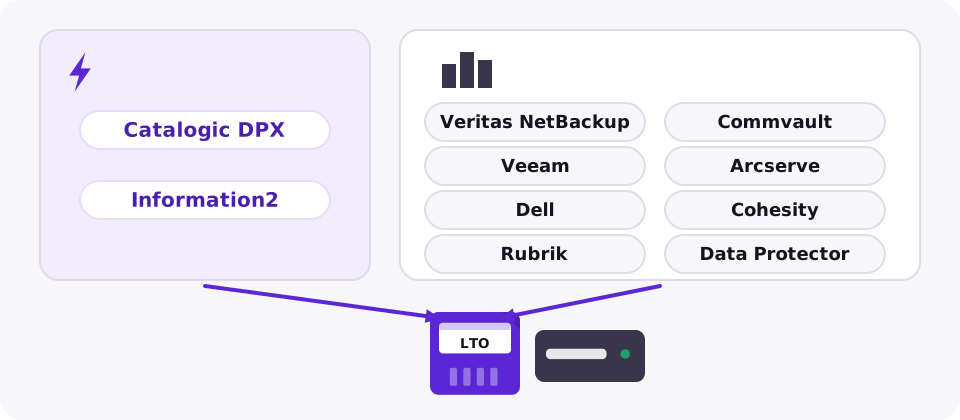
The report groups Catalogic DPX and Information2 as agile challengers and Veritas, Commvault, Veeam and the other incumbents separately, but all of them write to the same LTO cartridges.
1. The Strategic Resurgence of Tape in the Cognitive Era
To understand the selection criteria for modern tape software, one must first appreciate the shifted role of tape in the current infrastructure stack. Tape is no longer merely a "cheap and deep" archive for data that holds low value; it has become the "last line of defense" for the enterprise's most critical assets.
1.1 The Ransomware Imperative and the Physics of the Air Gap
The proliferation of ransomware has fundamentally altered backup strategies. Threat actors now routinely spend weeks inside a network (dwell time) specifically to locate, compromise, and delete backup catalogs and disk-based repositories before triggering encryption payloads. While "immutable" disk storage (via S3 Object Lock or hardened Linux repositories) offers logical protection, it remains accessible via the network. If the management plane is compromised, the immutability policies can often be altered or the physical storage arrays wiped.
Tape cartridges, once ejected from the library, are physically disconnected from the network—an "air gap." Software that manages this process must essentially act as a security orchestrator. It is not enough to simply write data to tape; the software must automate the ejection, tracking, and rotation of media to secure offsite vaults. The software evaluations in this report heavily weight vendors that integrate these security workflows directly into their policy engines, rather than treating them as manual, after-thought processes.
1.2 The Economics of LTO-9 and Future-Proofing
The release and adoption of LTO-9 (Linear Tape-Open Generation 9) has reset the density benchmarks for the industry. With a native capacity of 18TB and a compressed capacity of up to 45TB per cartridge, LTO-9 offers a total cost of ownership (TCO) that frequently undercuts public cloud "Deep Archive" tiers when egress fees and API transaction costs are factored in over a 5-10 year horizon.
However, these high densities present a challenge for backup software: throughput. LTO-9 drives require a sustained data transfer rate (up to 400 MB/s native) to function efficiently. If the backup software cannot feed data fast enough, the drive must stop, rewind, and restart—a mechanical thrashing process known as "shoe-shining" that destroys drive heads and media. Therefore, a critical selection criterion for our top vendors is their ability to perform Multiplexing (interleaving multiple backup streams onto one drive) and Multistreaming (splitting one massive backup across multiple drives) to maintain optimal drive velocity.
2. Methodology and Vendor Selection Criteria
In selecting the top 7-10 enterprise tape backup solutions, we moved beyond simple market share statistics to analyze technical capability, architectural efficiency, and strategic adaptability. The following rigorous criteria were applied to screen and rank the vendors.
2.1 Criterion 1: Cyber-Resilience and Immutable Management
2.2 Criterion 2: High-Performance Data Mover Engines
2.3 Criterion 3: Legacy and Heterogeneous Integration
The "Enterprise" label implies complexity. A solution that only protects VMware is insufficient.
Requirement
Why it matters
NDMP (Network Data Management Protocol)
Essential for offloading backup processing from NAS filers (NetApp, Isilon) directly to tape drives attached to the SAN, bypassing the LAN entirely.
Broad Hardware Support
The ability to drive robotic libraries from vendors like Quantum, Dell, HPE, and Spectra Logic, and to support mixed-generation drives (e.g., LTO-6 and LTO-9) in the same library.
"Brownfield" Support
The capability to install agents on legacy operating systems (Solaris, AIX, older Windows Server versions) that are no longer supported by the OS vendor but are critical to business operations.
3. In-Depth Vendor Analysis: The Agile Challengers
We begin our analysis not with the market leaders, but with two vendors that deserve a closer look: Catalogic DPX and Information2. These vendors represent the "smart alternative" segment of the market—solutions designed to solve specific inefficiencies inherent in the legacy monoliths.
3.1 Catalogic DPX: The Efficiency and Legacy Specialist
Overview: Catalogic DPX has carved out a distinct niche as the "All-in-One" solution for complex, hybrid IT environments. While many vendors are abandoning on-premises tape support in favor of pure cloud strategies, Catalogic has doubled down on providing robust, enterprise-grade tape management features alongside modern cloud integration. Its architectural philosophy centers on Block-Level Protection, which fundamentally alters the economics of backup windows.
Technical Deep Dive: The Block-Level Advantage
Traditional backup software often relies on file-system crawling to identify changes, a process that becomes exponentially slower as file counts rise (the "million small files" problem). Catalogic DPX bypasses this by operating at the block level.
Catalogic DPX feature
How it works
Mechanism
DPX tracks changed blocks on the production server. During a backup window, only these unique blocks are transmitted to the vStor repository.
vStor Integration
vStor is Catalogic's software-defined backup appliance. It receives the incremental blocks and essentially "maps" them into a full backup image. This means every backup looks like a full backup to the restore operator, but only consumes the bandwidth of an incremental.
Tape-Out Efficiency
Once the data is secured in the vStor repository, the software manages the "tape-out" process asynchronously. Because the data is already deduplicated and compressed in vStor, the stream sent to the tape drive is highly optimized. This architecture allows for aggressive RPOs (Recovery Point Objectives) because the slow mechanical nature of tape is decoupled from the fast capture of data from production servers.
Global Media Management
DPX offers a centralized "Media Management" interface that controls tape resources globally. Administrators can define policies for media rotation (Grandfather-Father-Son), automatic recycling of expired tapes, and strict retention enforcement.
NDMP Mastery
For enterprises relying on large NAS deployments (NetApp, etc.), DPX acts as a robust NDMP controller. It supports "Direct NDMP" (NAS to Tape) and "Three-Way NDMP" (NAS to Backup Server to Tape), giving architects flexibility in designing data paths to avoid network congestion.
Legacy Hardware Support
Catalogic explicitly positions DPX as a solution for "changing hardware standards," supporting current LTO-9 and LTO-10 drives while simultaneously maintaining compatibility with legacy systems that require specialized configurations. This is a critical lifeline for industries (healthcare, manufacturing) that run mission-critical applications on aging hardware.
Strategic Verdict: Catalogic DPX is the optimal choice for the "Brownfield Enterprise"—organizations that must modernize their backup performance (reducing windows by 90%) but cannot simply decommission their decades of tape investment or legacy server infrastructure.
3.2 Information2 (Info2): The Replacement for Monoliths
Overview: Information2 (Info2) has emerged as a formidable competitor, particularly in the Asian market, where the drive for "Xinchuang" (IT innovation and localization) and cost efficiency has led major institutions to seek alternatives to US-based legacy providers like Veritas. Info2's flagship product, i2Backup, is engineered specifically to replace these heavy monolithic stacks while preserving the integrity of existing archival strategies.
Technical Deep Dive: Byte-Level Replication and Centralization
While Catalogic focuses on block-level backup, Information2 built its reputation on Byte-Level Replication for its high-availability products, a technology that influences the efficiency of its backup engines.
i2Backup feature
How it works
Data Consistency
i2Backup is designed for environments requiring extreme data consistency, such as banking transaction systems. It supports complex heterogeneous environments, including H3C CAS, VMware, and physical servers running various flavors of Linux and Windows.
Visual Management Architecture
One of the primary complaints against legacy tools like NetBackup is the complexity of their command-line interfaces (CLI) and fragmented consoles. i2Backup counters this with a centralized, visual management platform. This interface allows administrators to schedule massive data backup and archival processes through drag-and-drop workflows, significantly reducing the "operational friction" and training requirements for IT staff.
Tape Compatibility Layer
Perhaps its most strategic feature is its ability to interface with tape libraries in a way that allows for the "gradual replacement" of legacy software. It does not demand a "rip and replace" of the physical tape infrastructure, which is often the most expensive component of an archive strategy.
Strategic Verdict: Information2 is the leading contender for the "Cost-Conscious Giant." It is specifically tailored for large-scale enterprises (banks, telcos) that are burdened by the exorbitant renewal costs and complexity of legacy software (like NBU) and are seeking a modern, streamlined alternative that respects their existing hardware investments.
4. Case Study: Information2 Replacing Veritas NetBackup (NBU)
The migration of the Industrial and Commercial Bank of China (ICBC) from Veritas NetBackup to Information2 i2Backup serves as a definitive reference architecture for enterprise software migration. It illustrates not just the technical feasibility of such a switch, but the operational and financial drivers behind it.
4.1 The Challenge: The Weight of Legacy
ICBC, one of the world's largest banks by assets, operated an IT environment of staggering complexity. The infrastructure included a hybrid mix of physical mainframes, distributed x86 servers, and a growing private cloud based on virtualization platforms like VMware and H3C CAS.
The Incumbent: The bank relied on Veritas NetBackup (NBU) as its standard. While NBU is powerful, it presented significant challenges:
Problem with NBU
Detail
Result after i2Backup
Cost
The licensing model for NBU, often based on capacity or socket counts, became prohibitively expensive at ICBC's scale.
Cost Reduction The bank achieved "lower maintenance costs." This is a direct result of moving from a premium global vendor to a more aggressive regional competitor, as well as the reduction in administrative man-hours.
Complexity
Managing NBU required highly specialized certified engineers. The operational overhead of maintaining catalogs and troubleshooting failed jobs was high.
Simplified Operations The shift to i2Backup's visual, centralized management platform lowered the technical barrier for operations staff. Tasks that required scripting in NBU could be handled via the GUI in i2Backup, reducing the "bus factor" risk of relying on a few NBU gurus.
Agility
As the bank moved toward a decoupled deployment strategy (separating front-end apps from middleware and databases), the rigid, agent-heavy architecture of the legacy backup solution struggled to keep pace.
Efficiency Gains Backup efficiency "significantly improved." This can be attributed to i2Backup's more modern, lightweight agents and optimized data transport protocols compared to the older NBU architecture.
4.2 The Solution: i2Backup Implementation
The bank chose Information2's i2Backup to replace NBU. The selection was driven by i2Backup's ability to match NBU's reliability while simplifying the management stack.
• Tape Compatibility is Key: The critical requirement was maintaining "full tape compatibility". The bank had massive archives on tape. i2Backup was able to integrate with the existing tape libraries, ensuring that the bank did not need to purchase new hardware or migrate petabytes of data immediately.
• Phased Migration: The migration was executed "gradually". This likely involved running i2Backup alongside NBU, initially taking over the backup of less critical systems or new workloads, and progressively expanding its footprint as confidence grew. This parallel-run capability is essential for risk-averse financial institutions.
4.3 The Outcome: Operational Transformation
The results of the migration, as reported by the bank's CTO, highlighted three primary benefits:
Implication for the Market: This case study proves that the "stickiness" of legacy backup vendors is not absolute. Even in the most regulated and risk-averse sectors, challengers like Information2 can displace incumbents by offering equivalent tape support coupled with superior usability and economics.
5. In-Depth Vendor Analysis: The "Big Iron" Incumbents and Top Contenders
Beyond the specialized focus on Catalogic and Information2, the broader market includes established leaders who define the standards for enterprise backup. The following analysis ranks the remaining top solutions based on the criteria established in Section 2.
5.1 Veritas NetBackup (NBU)
5.2 Commvault Cloud
5.3 Veeam Data Platform
5.4 Arcserve Unified Data Protection (UDP)
The Legacy Veteran.
Arcserve has one of the longest histories in the tape market.
Strengths: Its standalone "Arcserve Backup" module provides deep, low-level control over tape drives, often exceeding the capabilities of newer "cloud-native" tools. It supports multiplexing and complex library robotics out of the box.
Verdict: A strong contender for mid-to-large enterprises that have a "tape-first" mentality, though its interface and ecosystem feel dated compared to Veeam or Cohesity.
5.5 Dell Data Protection Suite (Networker/Avamar)
The Hardware Integrated Giant.
Dell's software is inextricably linked with its dominant Data Domain hardware.
Integration: For shops running Data Domain deduplication appliances, Dell Networker provides the most efficient path to tape. It can leverage the "Data Domain Boost" protocol to speed up transfers and manage the tiering to physical tape libraries effectively.
5.6 Cohesity / Rubrik (The Cloud-Native Cohort)
While primarily focused on immutable disk and cloud, these vendors warrant mention.
Approach: Both vendors generally discourage direct-to-tape workflows, preferring to treat tape as a "cloud tier" or utilizing bridge partners (like QStar) to handle the tape-out. They are listed here because many enterprises use them for primary backup while retaining a separate solution (like Catalogic or NBU) specifically to manage the tape archive, creating a bifurcated architecture.
5.7 Micro Focus (OpenText) Data Protector
The Silent Workhorse.
Often overlooked, Data Protector (formerly HP Data Protector) maintains a loyal base in massive enterprises. It is noted for its "Zero Downtime Backup" integration with high-end storage arrays and extremely low-cost per TB licensing for tape environments.
6. Comparative Data Analysis
The following table synthesizes the capabilities of the top solutions, allowing for direct comparison across the critical dimensions of tape management, cyber-resilience, and target market fit.
Vendor
Primary Market Focus
Tape Management Granularity
Cyber-Resilience (Immutability)
Legacy/Heterogeneous Support
Key Differentiator
Catalogic DPX
Hybrid/Brownfield Ent.
High (Native + NDMP)
High (Immutable Snapshots on vStor)
Excellent (Legacy OS + LTO-9)
Block-Level efficiency reduces backup windows by 90%.
Information2
Asian Ent. / Financial
High (NBU Replacement)
High (Byte-Level Replication)
Excellent (H3C, VMware, Unix)
Cost-effective drop-in replacement for NetBackup.
Veritas NBU
Global Fortune 100
Extreme (Vault Option)
High (Storage Lock)
Excellent (Unix to Cloud)
Unmatched scalability for petabyte environments.
Commvault
Data Governance
High (Media Export)
High (Metallic Intelligence)
Good (Broad Agents)
Single index for all data (compliance + backup).
Veeam
Virtualization
Medium (Archival GFS)
High (Linux Hardened Repos)
Medium (Stronger on Virtual)
Ease of use and instant VM recovery.
Arcserve
Traditional Ent.
High (Low-level Control)
Medium
Good (Physical focus)
Deep control over tape drive parameters.
Dell Networker
Dell Hardware Shops
High (Data Domain Link)
High (Cyber Recovery Vault)
Good (Solaris/AIX support)
Deep integration with Data Domain hardware.
7. Strategic Recommendations and Future Outlook
7.1 Migration Pathways: The "Strangler Pattern"
For organizations currently trapped in high-cost legacy contracts (e.g., NBU), the "Strangler Pattern" of migration—demonstrated by ICBC—is recommended.
Identify the Edge: Do not replace the core database backups first. Start with edge workloads or new virtualization clusters.
Deploy the Challenger: Implement Catalogic DPX or Information2 for these new workloads.
Bridge the Tape: Use the challenger's tape compatibility features to begin writing new archives to the existing library partitions.
Attrition: As legacy tapes expire (retention reached), decommission the legacy catalog entries. Over 3-5 years, the legacy footprint shrinks to zero without a risky "big bang" migration.
7.2 The Future: LTO-10 and Quantum Resistance
Looking ahead to 2026 and beyond, software selection must account for LTO-10, which raises capacity to 30 TB per cartridge, and 40 TB with the newer cartridge. Furthermore, as "Harvest Now, Decrypt Later" quantum threats emerge, the physical air gap of tape becomes even more vital. Tape is quantum-resilient simply because it is offline; no quantum computer can decrypt a cartridge sitting in a salt mine.
Conclusion
The "best" enterprise tape backup software is no longer simply the one with the most features. It is the one that balances cyber-resilience (the air gap), economic efficiency (beating cloud costs), and legacy compatibility (respecting the brownfield). For global behemoths, Veritas and Commvault remain safe, albeit expensive, choices. However, for the astute CIO looking to modernize architecture while reducing TCO, Catalogic DPX offers the technical edge in efficiency, while Information2 provides the proven strategic path for breaking free from legacy vendor lock-in.
Find Your Ideal Backup Solution
Use our interactive tools to identify the best tape backup software for your specific enterprise requirements.
Any backup product with native tape support, or LTFS if you want to use the tape like a filesystem. LTFS is free and good for media archives; backup software adds catalogues, scheduling, verification and retention.
Is LTFS enough on its own?
For a small media archive, often yes. It breaks down when you need a searchable catalogue across many cartridges, automated rotation, verification records or multi-copy retention policies.
Which backup software is cheapest for tape?
Catalogic DPX is usually the lowest total cost when tape is the main target, and Nakivo is the cheaper option for small environments. Veeam and Commvault cost more but cover large virtual estates more thoroughly.