LTO storage keeps data on LTO tape cartridges that sit powered off in a library or on a shelf: an LTO-9 cartridge stores 18 TB native for about $5.14 to $7.17 per TB, cartridges are rated for 30 years, and a copy on the shelf is out of reach of ransomware.
Definition
What LTO storage is
LTO storage means keeping data on LTO (Linear Tape-Open) magnetic tape cartridges instead of on disks or in a cloud service. A drive writes the data to a cartridge, and the cartridge then sits in a library slot or on a shelf, powered off, until the data is needed again. It is the usual choice for archives, long-term backup copies and offline copies that ransomware cannot reach.
LTO is an open standard set by HPE, IBM and Quantum, so cartridges and drives of the same generation work together whatever the brand. The format itself is explained on what is LTO tape; this page is about using it as storage.
How it works
How LTO tape storage works
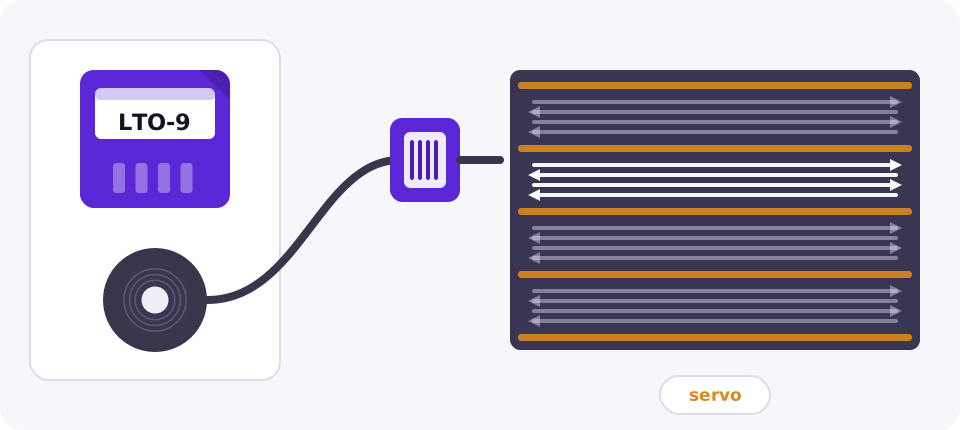
Each cartridge holds one reel of half-inch tape. The drive pulls the tape past its head and writes a band of parallel tracks along the whole length, then reverses and writes the next set on the way back. Servo bands written at the factory keep the head on track.
One reel per cartridge. When a cartridge is loaded, the drive pulls the tape out by its leader pin and winds it onto a reel inside the drive.
Linear serpentine recording. The head writes many tracks at once while the tape streams past, then shifts slightly and writes in the opposite direction. A full cartridge is written in many such end-to-end passes.
Servo tracks. Factory-written servo bands let the head follow the tape precisely, which is what allows thousands of tracks on half an inch of tape.
Verify while writing. The drive reads each block back just after writing it and rewrites it if needed, and every block carries error correction.
Compression and encryption in the drive. Drives compress data on the fly and, from LTO-4 onward, can encrypt it with AES-256.
Cartridge memory. A small chip in each cartridge records its history, such as how often it was loaded.
Because the tape is read in order, finding one file means winding to it, which takes tens of seconds to a couple of minutes. Reading or writing large amounts in sequence is fast: an LTO-9 drive streams up to 400 MB/s native.
The parts
What an LTO storage system is made of
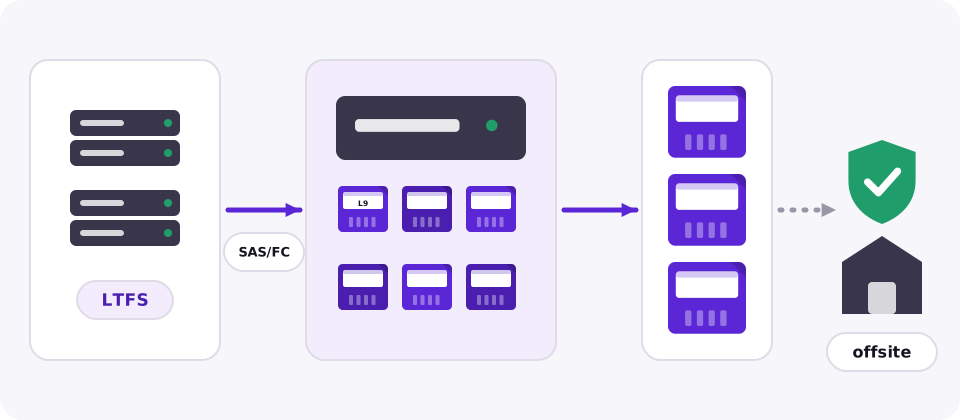
A working LTO storage system needs five things: cartridges, a drive or library, a server with the right connection, software that writes to tape, and somewhere safe to keep the second copy.
Plan with the native figure. Compressed capacity assumes data that compresses 2.5 to 1, and video, photos, encrypted files and existing backups barely compress. An LTO-6 cartridge, still common in older archives, holds 2.5 TB native. Every generation from LTO-1 to the LTO-14 roadmap is in the LTO capacity chart.
Prices are new seller listings checked on 23 October 2026. LTO-9 is the cheapest media per terabyte at $5.14 to $7.17; LTO-10 costs $8.63 to $10.00 per TB. The drive is the large fixed cost, so the cost per terabyte of the whole system falls the more data you store. For a full five-year comparison with cloud archive storage, see tape vs cloud cost, and for your own numbers use the backup calculator.
Fit
When LTO storage is the right choice
Good fit: archives that grow by tens of terabytes or more, a second or third backup copy that must be offline, data you must keep for years (research data, video masters, medical images, records), and anyone who wants storage with no monthly bill and no power draw while idle.
Poor fit: small data sets below roughly 15 TB, where disks or cloud storage cost less than a drive; data that users open every day; and teams with nobody to handle cartridges, rotation and restore tests. For those, disk or object storage usually works better. See LTO vs object storage and tape, disk and cloud compared.
Keeping cartridges
How LTO cartridges should be stored
For long-term storage, keep cartridges cool, dry and stable, in their cases, standing on edge, away from dust, sunlight and strong magnetic fields, and give them time to adjust to the room before loading them in a drive. Keep a second copy at another site. The full checklist, with temperature and humidity figures, cases, cabinets, racks and offsite rotation, is in how to store LTO tapes.
Choosing software
Which software writes to LTO storage
Backup software such as Veeam or Commvault treats tape as a target for backup copies. Archive software moves files to tape and keeps a catalogue, and LTFS lets a single cartridge be mounted like a disk. To compare backup products, use the tape backup software finder; for archive products, try the tape archive advisor.
LTO storage is keeping data on LTO (Linear Tape-Open) tape cartridges. A drive writes the data, and the cartridges sit in a library or on a shelf, powered off, until the data is needed. It is used for archives, long-term backup copies and offline copies.
How does LTO tape storage work?
The drive pulls the tape from the cartridge past its head, writes bands of parallel tracks along the whole tape, then reverses and writes the next band, guided by factory-written servo tracks. It verifies each block as it writes and can compress and encrypt the data.
How much data can LTO storage hold?
An LTO-9 cartridge holds 18 TB native and an LTO-10 cartridge 30 TB, or 40 TB on the newer cartridge. LTO-8 holds 12 TB and LTO-6 2.5 TB. A library multiplies that by its number of slots.
How much does LTO tape storage cost per TB in 2026?
LTO-9 media costs about $5.14 to $7.17 per TB as of 23 October 2026, the lowest of any generation, and LTO-10 about $8.63 to $10.00. A drive adds a fixed cost of $8,009 to $13,329 for a new internal LTO-9 drive.
What is an LTO storage system?
Cartridges, a drive or tape library, a server connected by SAS, Fibre Channel or Thunderbolt, backup or archive software or LTFS, and a place to keep the second copy offsite.
Is LTO storage still used?
Yes. LTO shipped 160.3 exabytes of capacity in 2025 and shipments rose 57% in the first quarter of 2026, mainly for archives, AI training data and offline backup copies.