Object storage answers in milliseconds but charges every month; LTO tape answers in minutes from a library but two copies of 100 TB on LTO-9 cost $9,118 to $14,877 once, and offline cartridges are out of reach of ransomware, so most large archives use both.
The short answer
LTO tape or object storage?
Object storage (Amazon S3 and services that speak the same API, in the cloud or on your own servers) keeps every object online behind an API, so any application can read it in milliseconds. LTO tape keeps data on cartridges that are mostly offline, so a read takes minutes in a library, but each terabyte costs a fraction of standard object storage to keep for years, and a cartridge on a shelf is out of reach of attacks on the network.
Most organisations that hold a lot of data use both: object storage for data that is read often, and tape for the archive and the offline copy. Several products now present tape itself through an S3 interface, which is covered below.
Access and cost
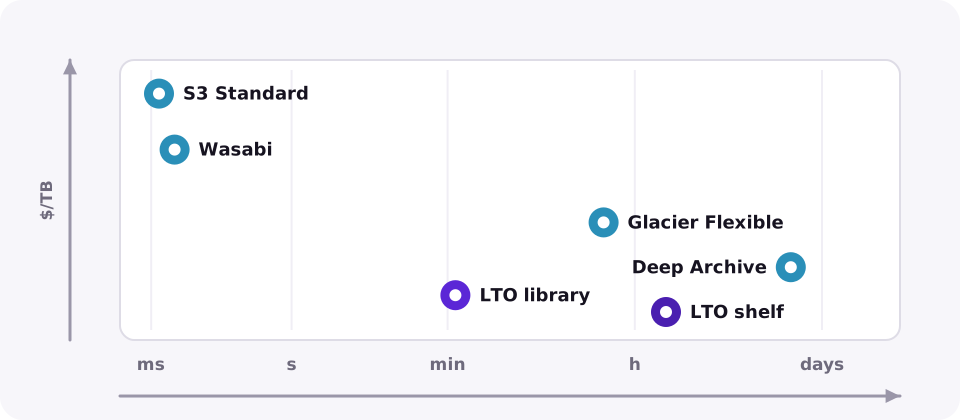
Access time against cost per terabyte
Object storage classes answer in milliseconds and cost the most per terabyte; cloud archive classes are cheap but take hours to restore; LTO tape in a library answers in minutes at the lowest cost per terabyte. The positions are schematic, not to scale.
Tape: two copies of 100 TB on LTO-9 cartridges plus 1 internal drive, at new seller prices checked on 23 October 2026; the cartridges are bought once. Cloud: list storage prices for US East times five years, before request, retrieval and egress fees, checked on 17 October 2026. Reading all 100 TB back out of Glacier Deep Archive with bulk retrieval and internet egress adds about $8,615. Object storage keeps one logical copy across several devices or sites; tape keeps exactly the copies you make, so the two-copy figure is the fair comparison.
Milliseconds for standard classes, hours for cloud archive classes
Throughput
Up to 400 MB/s native per LTO-9 drive, more with more drives
Scales with parallel requests and network bandwidth
Ransomware protection
Offline cartridges are physically out of reach; WORM media cannot be rewritten
Object Lock or immutability settings, enforced by the service
Ongoing cost
Almost none once written; no power while on a shelf
A monthly charge for every terabyte, plus requests and egress
Lock-in
Open LTO format and LTFS; plan migrations every few generations
API is standard, but egress fees make leaving expensive at scale
Skills
Cartridge handling, rotation, restore tests
Buckets, access keys, lifecycle policies
Both at once
S3 on top of tape
An S3-to-tape gateway accepts objects through the S3 or S3 Glacier API and writes them to LTO cartridges in a library, often keeping recent objects on disk. Applications that already speak S3 can then archive to tape without tape-specific software. Examples scored in our Ledger include Spectra BlackPearl, Grau Data XtreemStore, PoINT Archival Gateway, Versity ScoutAM with its S3 gateway, and QStar. To compare them for your own data size and team, try the tape archive advisor.
Decision
When to choose which
Choose object storage when applications read the data often, when you need it from anywhere, or when the data set is small (below roughly 15 TB, a drive costs more than years of cloud storage).
Choose LTO tape for archives that grow by tens of terabytes or more, for data you must keep for many years, and for the offline copy in a 3-2-1 plan.
Use both when the archive must be reachable by S3 applications but stored cheaply: put an S3-to-tape gateway in front of a library, or keep hot data in object storage and tier the rest to tape.
How LTO storage works and what it costs per terabyte today is in LTO storage explained.
Than standard object storage such as S3 Standard or Wasabi, yes, by a wide margin: two copies of 100 TB on LTO-9 cost $9,118 to $14,877 once, drive included. Against cloud archive tiers it depends on size and restores: five years of 100 TB in Glacier Deep Archive costs $5,532 in storage, less than tape, but reading it all back once adds about $8,615. From about 500 TB, or with regular restores, tape costs less.
Is LTO tape faster than object storage?
For streaming large files, an LTO-9 drive writes up to 400 MB/s native. For the first byte of a random file, object storage is far faster: milliseconds against about a minute or two for tape in a library.
Can I use S3 with tape?
Yes. S3-to-tape gateways such as Spectra BlackPearl, Grau Data XtreemStore and PoINT Archival Gateway accept S3 or S3 Glacier requests and store the objects on LTO cartridges.
Is object storage safe from ransomware?
It can be, with Object Lock or immutability enabled and strict access keys. Tape adds a physical air gap: a cartridge on a shelf cannot be reached over the network at all.
Should I replace tape with object storage?
Usually not completely. Many sites keep frequently used data in object storage and use tape for the archive and the offline copy, because tape costs less per terabyte the longer data is kept.