What is LTO? Understanding Linear Tape-Open Technology
LTO stands for Linear Tape-Open, a magnetic tape data storage technology designed for backup, data archiving, and data transfer applications. Also known as the LTO Ultrium format, this open-standard technology has become the dominant force in enterprise data storage, revolutionizing how organizations protect and preserve their critical information.
Developed in the late 1990s by technology giants IBM, Hewlett-Packard (HP), and Seagate, LTO was created as an open-standards alternative to proprietary magnetic tape formats available at that time. Upon its introduction in 2000, LTO rapidly defined the "super tape" market segment and has consistently remained the best-selling tape format worldwide.
Defining Linear Tape Technology
The term "linear tape" in LTO's name refers to the way data is written and read on the medium. Unlike helical scan tape formats that use rotating drum heads (similar to VCR technology), linear tape employs a stationary read/write head while the tape moves past it in a linear fashion. This linear recording method uses multiple parallel tracks written sequentially along the length of the tape, providing high-capacity storage with excellent reliability.
LTO cartridges contain hundreds of meters of half-inch (12.65 mm) wide magnetic tape wound onto a single reel. When inserted into a tape drive, the tape is extracted from the cartridge and spooled onto a second reel inside the mechanism, allowing data to be read or written as the tape moves between the reels.
The "Open" Advantage: What Makes LTO Different
The "Open" in Linear Tape-Open represents one of LTO's most significant advantages. Unlike proprietary formats controlled by single vendors, LTO specifications are publicly available and maintained by the LTO Consortium, enabling multiple manufacturers to produce compatible drives, media, and libraries. This open-format approach ensures:
Vendor Independence
Organizations can choose from multiple competing vendors for drives and media, preventing vendor lock-in and encouraging competitive pricing.
Interoperability
LTO cartridges and drives from different manufacturers are designed to work together, following strict compatibility standards verified through certification testing.
Innovation and Competition
The open standard fosters continuous innovation as multiple technology providers compete to deliver better performance and features.
Investment Protection
With a published roadmap extending to LTO-14 (projected for the 2030s), organizations can confidently plan for future technology needs knowing their investments remain viable.
LTO Evolution: From 100GB to Petabyte Scale
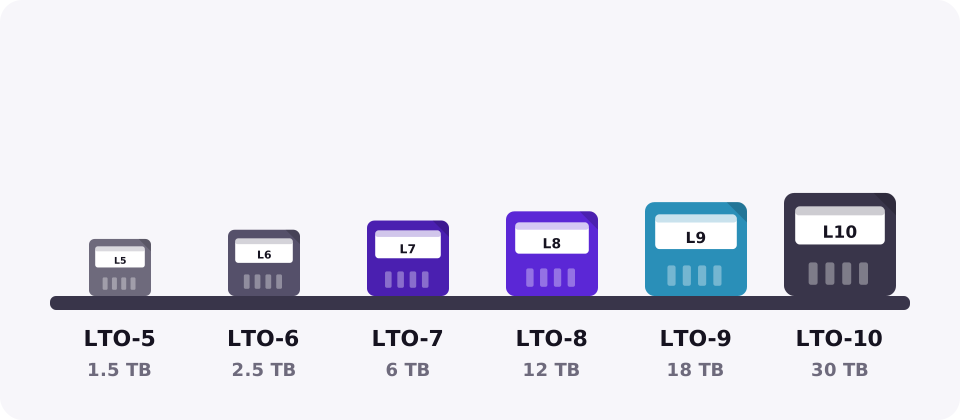
Since the first LTO-1 generation launched in 2000 with 100 GB native capacity, LTO technology has undergone remarkable evolution. Each generation has brought substantial increases in capacity and performance:
LTO-1
2000
100 GB
20 MB/s
LTO-2
2003
200 GB
40 MB/s
LTO-3
2005
400 GB
80 MB/s
LTO-4
2007
800 GB
120 MB/s
LTO-5
2010
1.5 TB
140 MB/s
LTO-6
2012
2.5 TB
160 MB/s
LTO-7
2015
6 TB
300 MB/s
LTO-8
2017
12 TB
360 MB/s
LTO-9
2021
18 TB
400 MB/s
LTO-10
2026
30 TB
400 MB/s
The LTO roadmap extends to LTO-14, projected to deliver 576 TB native capacity and break the petabyte barrier with 1.44 PB of compressed storage per cartridge.
How LTO Tape Works: Technical Architecture
LTO tape employs sophisticated magnetic recording technology to achieve its high capacities. Modern LTO cartridges use advanced magnetic particles—such as Barium Ferrite (BaFe) in LTO-7 through LTO-9, and proprietary "fine hybrid magnetic particles" combining Strontium Ferrite and Barium Ferrite in LTO-10.
Track Structure
Each LTO tape is divided into multiple data bands separated by servo bands. For example, LTO-9 contains four data bands with five servo bands, creating 8,960 tracks across the tape surface. The servo bands act as "guard rails," helping the read/write head maintain precise positioning.
Multiple Read/Write Heads
LTO drives feature multiple read/write head elements (typically 8, 16, or 32 heads) that can simultaneously read or write multiple tracks in a single pass. This parallel recording significantly increases data transfer rates.
Bidirectional Recording
LTO tapes can be written in both directions, with the head writing data in one direction, then shifting to another set of tracks and writing in the opposite direction. This bidirectional capability maximizes efficiency and reduces mechanical wear.
Sequential Access
Unlike random-access storage like hard drives, tape is a sequential medium. To access specific data, the drive must physically move the tape to the location where that data resides, which can take seconds to minutes depending on the file's position on the tape.
Key Features and Capabilities
Backward Compatibility
LTO technology has maintained backward compatibility across generations, though the rules have evolved:
LTO-1 through LTO-7: Drives could read tapes from two generations back and write to tapes from one generation back
LTO-8 and LTO-9: Read and write compatibility limited to one generation back
LTO-10: No backward compatibility; only reads and writes LTO-10 media
Linear Tape File System (LTFS)
Introduced with LTO-5, LTFS revolutionized tape usability by enabling users to treat LTO cartridges like removable hard drives. With LTFS, users can drag and drop files to tape through standard file explorers, eliminating the need for specialized backup software for basic archiving tasks.
WORM Technology
Write Once, Read Many (WORM) functionality, available from LTO-3 onward, ensures that once data is written to a WORM tape, it cannot be altered or deleted. This immutability is critical for industries with strict compliance and regulatory requirements, such as healthcare, finance, and legal services.
Hardware Encryption
Starting with LTO-4, all LTO generations support AES 256-bit hardware-based encryption. Data is encrypted before being written to tape, protecting sensitive information from unauthorized access even if tapes are lost or stolen. LTO-10 introduces quantum-safe encryption capabilities to protect against future cryptographic threats.
LTO Use Cases and Applications
Long-Term Archiving
LTO tape excels at storing data that must be retained for years or decades. With proper storage conditions, LTO cartridges can preserve data for 30 years or more, making them ideal for legal documents, medical records, scientific research data, and historical archives.
Backup and Disaster Recovery
Organizations worldwide rely on LTO technology for creating secure backup copies of critical data. In the event of system failures, cyberattacks, or natural disasters, LTO tapes provide a reliable recovery point, enabling businesses to restore operations quickly.
Data Transfer
When transferring massive datasets between locations, physically shipping LTO tapes can be faster and more cost-effective than network transfers. A single LTO-9 tape containing 18 TB of data can be shipped overnight, avoiding days or weeks of network transfer time.
Media and Entertainment
The film, television, and music production industries extensively use LTO tape to archive large media files, including raw video footage, uncompressed audio, and complex visual effects projects.
Cold Storage
For data that is rarely accessed but must be retained, LTO provides the most cost-effective cold storage solution. Unlike hard drives that must remain powered, LTO tapes consume zero energy when stored offline.
Compliance & Regulatory
Meet data retention requirements with auditable, immutable storage. WORM tapes ensure regulatory compliance for industries like healthcare (HIPAA), finance (SOX), and government.
LTO vs. Other Storage Technologies
LTO vs. Cloud Storage
While cloud storage offers accessibility and scalability advantages, LTO tape provides superior cost-effectiveness for long-term retention, especially at scale. LTO offers lower total cost of ownership, with tape media costing roughly $5 to $7 per TB on LTO-8 and LTO-9 compared to ongoing cloud subscription fees. Additionally, LTO's offline nature provides inherent security against cyberattacks that cloud-connected systems cannot match.
LTO vs. Hard Disk Drives
For frequently accessed data, hard drives offer faster random access. However, for archival and backup applications, LTO provides significantly lower cost per terabyte, longer media lifespan (30+ years vs. 3-5 years for HDDs), and zero power consumption when offline. Organizations often use both technologies in tiered storage architectures.
Cost Economics of LTO
Media Costs
LTO tape cartridges offer exceptional value for bulk storage. LTO-8 tapes (12 TB native) cost about $70 to $85 in October 2026, roughly $5.85 to $7.03 per TB. LTO-9 tapes (18 TB native) cost $5.14 to $7.17 per TB, while LTO-10 30 TB tapes still cost $8.63 to $10.00 per TB.
Total Cost of Ownership
When comparing total cost of ownership over 5-10 years, LTO typically offers 50-80% lower costs than equivalent disk arrays for archival workloads. The primary investment is the tape drive itself (about $4,850 to $13,329 for new LTO-8 and LTO-9 drives in October 2026), with tape libraries ranging from $5,000 to hundreds of thousands of dollars for enterprise-scale robotic systems.
Environmental Benefits and Sustainability
Energy Efficiency
LTO tape's most significant environmental advantage is its zero power consumption when offline. Studies show that tape libraries can reduce energy consumption by 87% compared to equivalent hard drive capacity for cold storage applications.
Carbon Footprint Reduction
Organizations can achieve up to 97% reduction in CO2 emissions by moving cold data from disk to tape storage. If 60% of the world's cold data stored on hard drives migrated to tape, global CO2 emissions could be reduced by 72 million tons annually.
Reduced E-Waste
With a useful life of 30 years or more, LTO cartridges require far fewer media replacements than hard drives (typically 3-5 year lifespan). LTO cartridges are also constructed from 99% recyclable materials.
Lower Cooling Requirements
Cooling can account for 30 to 40% of a data center's energy use. By moving infrequently accessed data to offline tape storage, organizations dramatically reduce cooling infrastructure requirements.
Ransomware Protection: The Air Gap Advantage
In an era of sophisticated ransomware attacks, LTO tape provides the ultimate defense through physical air-gapping. When a tape cartridge is ejected from the drive and stored offline, it becomes completely disconnected from the network—there is no IP address to attack, no network share to corrupt, and no online vulnerability for malware to exploit.
Statistics reveal that 76% of organizations have suffered ransomware attacks, with cybercriminals specifically targeting backups in 94% of incidents. LTO's offline storage breaks this attack chain, ensuring that verified, clean backup copies remain available for recovery even after catastrophic attacks.
The immutability of WORM tape adds another layer of ransomware defense. Once data is written to WORM media, it cannot be altered or deleted by any means, guaranteeing data integrity regardless of what happens to online systems.
The Future of LTO: Roadmap to LTO-14
The LTO Consortium published an ambitious roadmap in September 2022 that extends to LTO-14, expected in the early 2030s. This roadmap projects continuous capacity doubling with each generation:
LTO-11
~2027
72 TB native
180 TB compressed
LTO-12
~2030
144 TB native
360 TB compressed
LTO-13
~2033
288 TB native
720 TB compressed
LTO-14
~2036
576 TB native
1.44 PB compressed
Research demonstrations by IBM and Fujifilm in 2020 proved the technical feasibility of storing 580 TB natively on a tape cartridge using next-generation Strontium Ferrite magnetic particles. This breakthrough validates the roadmap's long-term trajectory and confirms tape technology's continued relevance for decades to come.
Conclusion: Why LTO Remains Essential
More than 25 years after its introduction, Linear Tape-Open technology continues to evolve and thrive, serving as the backbone of enterprise data protection worldwide. Its combination of massive capacity, exceptional cost-efficiency, decades-long media lifespan, and inherent security through air-gapping makes LTO uniquely suited for modern data challenges.
As organizations grapple with exponential data growth, escalating storage costs, increasingly sophisticated cyber threats, and mounting pressure for sustainable IT practices, LTO tape provides proven solutions that no other technology can match.
Whether for regulatory compliance, disaster recovery, ransomware defense, or simply cost-effective long-term preservation of valuable data, Linear Tape-Open technology deserves serious consideration in any comprehensive data management strategy. Far from being a legacy technology, LTO represents a mature, reliable, and continuously advancing solution for one of the most critical challenges organizations face: ensuring their data remains safe, accessible, and affordable for as long as needed.
Current prices
Check current LTO prices
Prices on this page are rounded guidance. For seller listings checked in September 2026, see the LTO price tracker and the price history.