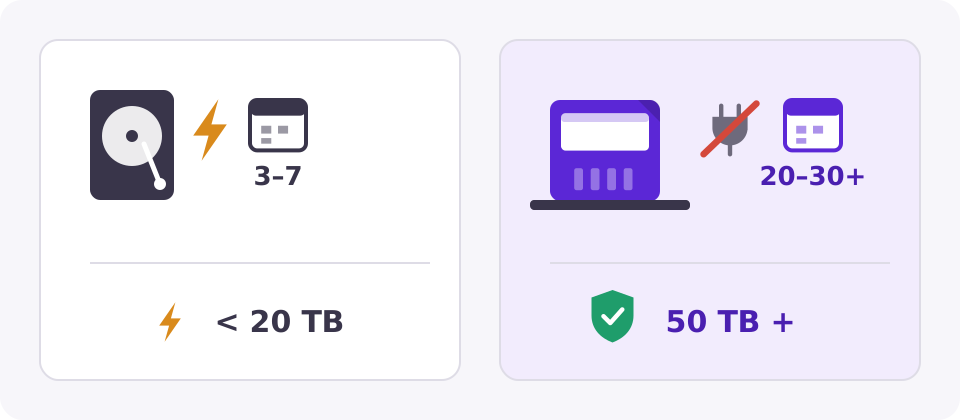
LTO vs HDD: Core Differences
| Feature | LTO Tape | HDD (Hard Disk Drive) |
|---|
| Designed For | Archival storage | Active storage & frequent access |
| Lifespan (rated) | 20–30+ years | 3–7 years typical |
| Power Requirement | None when stored | Requires power periodically |
| Cost per TB (long-term) | Very low | Moderate |
| Access Speed | Sequential | Random access |
| Maintenance | Minimal | Requires monitoring |
| Best Use Case | Cold backups | Live systems & fast restores |
If your goal is tape vs disk for long term storage, the intended use matters more than raw speed.
Why Choose LTO Tape for Archive Storage
1️⃣ Designed for Archival Use
LTO tape for archive storage is built specifically for long-term retention. Once written, tapes can be stored offline without power, reducing wear and cyber risk.
2️⃣ True "Cold Storage"
Unlike HDDs, LTO tapes are completely offline when not mounted. This protects against:
Ransomware
Electrical damage
Firmware corruption
Power surges
3️⃣ Lower Cost Per TB Over Time
While the drive is expensive upfront, media cost is low. For large archives, LTO vs HDD often favors tape after scale increases.
4️⃣ Reduced Maintenance
Hard drives need periodic spin-ups and SMART monitoring. Tape is largely "write once, store safely."
Why Choose HDD for Backup
1️⃣ Faster Recovery
When comparing LTO tape vs hard drive for backup, HDD wins for speed. Random access means faster restores of individual files.
2️⃣ Lower Entry Cost
No special controllers, no SAS/Fibre Channel cards. Plug-and-play simplicity.
3️⃣ Better for Active Data
If you frequently modify files, HDD storage is more practical.
4️⃣ Easier Setup
Tape systems may require:
LTO vs HDD for Long-Term Storage: Real-World Scenarios
🎬 Media Collector
(Large Blu-ray Archive)
If storing hundreds or thousands of video files that rarely change, LTO tape for archive storage provides long-term stability and offline protection.
🏢 Small Business Backup
A hybrid approach often wins: HDD for daily backups, Tape for monthly or yearly archival copies.
🏠 Home Lab / Data Hoarder
If cost per TB matters and you can tolerate slower restores, LTO vs HDD often favors tape once storage exceeds ~50TB.
Tape vs Disk for Long Term Storage: Key Considerations
Lifespan
Tape media is rated for decades under proper storage. HDDs contain moving parts and are more failure-prone over long idle periods.
Environmental Sensitivity
Both can be damaged by humidity and mold. Proper storage conditions matter regardless of medium.
Scalability
Tape libraries scale efficiently for very large datasets. HDD arrays scale faster but require constant power and management.
| When LTO Is the Better Choice | When HDD Is the Better Choice |
|---|
| You need 10+ year retention | You need fast recovery |
| Data rarely changes | Data changes frequently |
| You want offline ransomware protection | You want simple deployment |
| Storage volume exceeds tens of terabytes | You have under 20TB total storage |
| You prioritize longevity over speed | Budget is limited upfront |
Final Verdict: LTO vs HDD
The LTO vs HDD decision depends on whether you value speed or longevity.
For cold archives →
LTO Tape
For active backup →
HDD
For optimal protection →
Use Both
In most serious backup strategies, tape and disk are complementary rather than competing technologies.
Frequently Asked Questions
Is LTO better than HDD for long-term storage?
Is LTO tape slower than a hard drive?
Yes. LTO tape vs hard drive for backup shows HDD is significantly faster for small file access and restores.
Can LTO replace HDD completely?
Not typically. Tape works best as archive storage, while HDD handles daily operational backups.
Is tape safer from ransomware?
Yes. Offline LTO tape for archive storage cannot be encrypted by network-based attacks when stored properly.
What is cheaper long term: tape vs disk?
For large-scale data retention, tape vs disk for long term storage often favors tape due to lower media cost and reduced power consumption.
Full Storage Comparison More About Why Tape Get Expert Advice