Tape software debates get weirdly ideological.
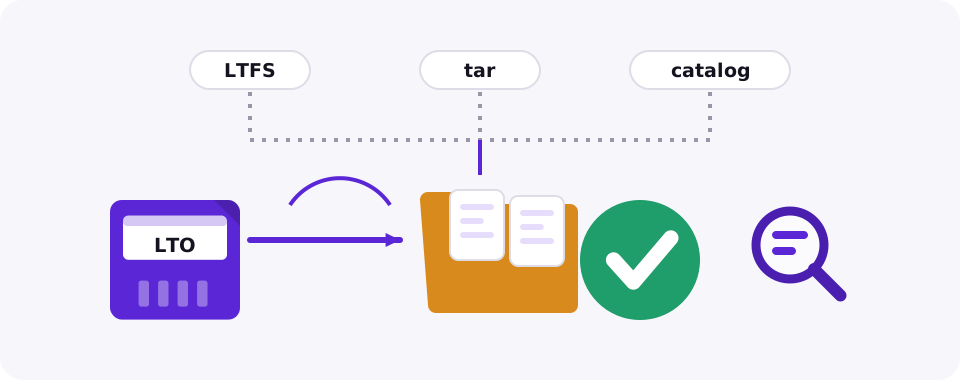
Ask a group of LTO users what they trust and the room splits almost immediately. One camp wants simple file visibility, usually through LTFS. Another wants archive containers like tar. Another insists that proper backup software with a catalog is the only adult answer. Then the enterprise crowd arrives with the usual heavyweight names and reminds everyone that “simple” stops being simple once you need disciplined restores.
All of them are arguing around the same fear: nobody wants to discover on a bad day that their tape workflow was only understandable to the version of themselves who set it up.
The real question is not write speed or elegance
It is recoverability.
That is why the software conversation refuses to die. LTFS is attractive because it feels transparent. Mount the tape, browse the files, and it looks less like backup magic and more like storage you can reason about. That is a real advantage, especially for teams with small archives or straightforward retention goals.
But the pushback is equally real. File-level visibility can create false confidence if the process around it is sloppy. Large archives spanning multiple tapes, inconsistent metadata, partial copies, and weak verification routines can turn “simple” into a mess fast. A workflow that looks clean in the mount dialog may still be brittle when you actually have to rebuild something important.
Tar-based approaches sound old-fashioned, but the appeal is not nostalgia. It is predictability. Some operators trust a few well-defined archive files more than millions of little assumptions scattered across media. If they know how the data was packed, how the manifests were kept, and how the restore path was tested, tar can feel more dependable than a friendlier-looking system.
Then there is the backup-software argument. Catalog-driven tools ask more from you up front, but they usually repay that discipline later. Retention handling improves. Spanning media gets less improvised. Scheduling becomes saner. Restore logic becomes less dependent on memory and tribal knowledge.
Tape workflows fail when operators confuse familiarity with reliability
That is the uncomfortable middle.
People often pick the method that feels most intuitive at the beginning, not the one that survives pressure best. A familiar command line, a mountable filesystem, or a trusted enterprise badge can all mask the same deeper problem: you still need restore drills.
The discussions around LTO software kept circling back to this. Even when users disagreed sharply on tools, they converged on process. They wanted logs. Manifests. Verification. A way to know which tape held what without guesswork. A way to rebuild after months or years, not just after lunch.
That is why the strongest software choices were not necessarily the flashiest ones. They were the ones people could describe operationally. What gets written first? How is media labeled? Where is the catalog stored? What happens if one tape is bad? How do you reconstruct the chain if the backup server itself is gone?
If the answers to those questions are vague, the workflow is probably weaker than it looks.
The best tape software is boring in the right ways
It makes restores legible. It creates habits instead of heroics. It lowers the number of assumptions required on a bad day.
For some teams, that will genuinely be LTFS paired with disciplined indexing and ruthless restore testing. For others, it will be tar plus careful manifests. For others, a full backup application like Bacula, Bareos, or a commercial suite will be the only thing that keeps the archive from becoming folklore.
The point is not that one camp is universally right. The point is that tape punishes people who choose based on aesthetics alone. A “clean” workflow that nobody rehearses is not clean. A powerful enterprise tool nobody understands is not powerful. A simple mountable tape nobody can verify is not simple.
The best LTO backup software is usually the one your team will actually test, document, and trust enough to use under pressure. Everything else is just style layered on top of risk.