Used enterprise tape drives have a special talent for making smart people doubt themselves.
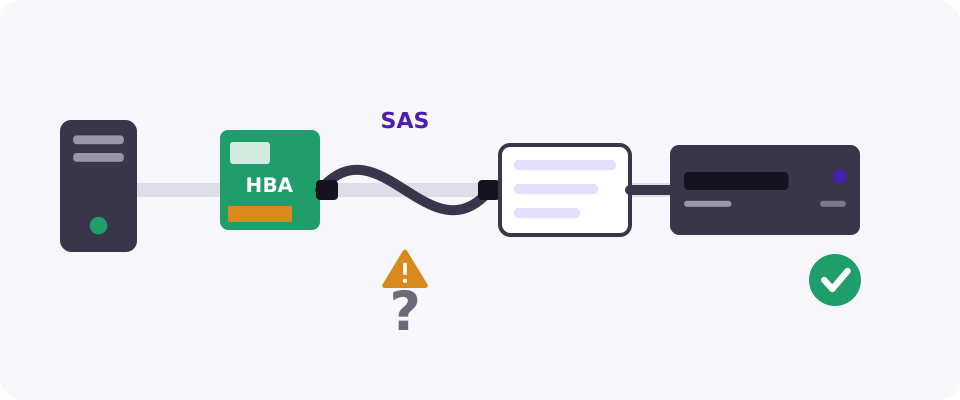
A drive shows up. It looks clean enough. The seller said it worked. You slot it into the plan, attach the cabling, boot the host, and then the confusion starts. The OS sees something strange. Or nothing at all. Or the wrong thing. Suddenly you are deep in adapter settings, firmware questions, connector diagrams, and search results from a decade ago.
At that point, most people assume the drive is dead.
That assumption is often premature.
Used LTO troubleshooting is usually a chain problem first
Recent conversations around secondhand IBM and HPE gear kept landing in the same place. Before you diagnose the tape drive, you have to diagnose the path. SAS controllers matter. Mode settings matter. External enclosures matter. Cable types matter more than anybody wants them to. What looks like a drive failure is frequently a negotiation failure somewhere upstream.
That is part of why these threads become so frustrating. The drive is the most expensive object in the setup, so it gets blamed first. But used tape hardware lives inside a stack of dependencies that all need to align. If the HBA firmware is wrong, if the card is in the wrong mode, if the cable is incorrect, if the host expects a different connector standard, or if the enclosure presents the device oddly, the drive can look dead while doing exactly what it is supposed to do.
The operator experience becomes one long argument with ambiguity.
Enterprise tape gear was not designed to reassure hobbyists
That sounds obvious, but it matters.
These devices came from environments where the surrounding assumptions were already solved. Proper host adapters. Known firmware baselines. Documented topology. Spare parts. Someone else had probably done this exact install path twenty times before. When that same drive lands in a lab or small shop, all of that invisible context disappears.
Now every component becomes suspect. Is the issue power? Firmware? Block size settings? Device visibility? Some weird seller-side reconfiguration? People start swapping ports, booting alternate systems, testing with vendor tools, and inspecting logs line by line. The work is less about tape itself and more about reassembling enough infrastructure truth to trust what the drive is telling you.
That is why patience becomes a technical skill here. Not because patience fixes hardware, but because tape troubleshooting punishes panic buys and premature conclusions.
The used-market opportunity is still real
Which is why people keep trying.
If secondhand tape gear were only pain, the market would not stay interesting. The reason people keep chasing it is that one successfully revived LTO-8 drive changes the math on serious archive capacity immediately. What felt like enterprise-only storage starts looking accessible. Suddenly long-retention planning, offline copies, and large staged backups are not abstract anymore.
That upside makes the troubleshooting worthwhile for the right buyer. But the right buyer is not just someone willing to spend money. It is someone willing to treat SAS, adapters, and diagnostics as part of the purchase price.
A used LTO drive is never just a drive. It is a small integration project with a tape mechanism attached.
That is the more honest way to frame the risk. Do that, and the whole situation becomes less mysterious. The question is not “Is this drive broken?” The better question is “Have I ruled out the entire path around it?”
Usually, that is where the real answer lives.