The Simple Question That Turns Into a Rabbit Hole
It starts off sounding like a basic decision: should you store files as-is, or bundle them into a single archive before writing to tape? But the moment you step into LTO workflows, that question stops being simple and starts feeling like a long-term commitment with real consequences .
The setup itself feels almost charmingly minimal. No enterprise software, no automation pipelines—just labeled tapes and a spreadsheet tracking what’s where. It’s manual, but it’s understandable. And for someone archiving creative work—video, EXR frames, project files—it feels personal. This isn’t just data. It’s years of work being preserved.
That’s why the decision matters so much. You’re not just choosing a format. You’re choosing how your work survives—or fails—years from now.
“Just Tar Everything” — The Efficiency Argument
One camp leans hard into tar archives. The reasoning is clean, almost elegant.
Fewer files means better streaming performance. Tape drives hate small files—they slow down, stutter, and fall into what people call “shoe-shining,” constantly stopping and starting. That’s bad for speed and worse for wear.
So the solution? Bundle everything into large chunks. One person prefers 1.3TB tar files, letting the drive run smoothly for hours, verifying everything afterward with hashes to ensure nothing broke during the write process .
There’s a certain confidence in this approach. It’s efficient. It’s controlled. It turns messy directories into clean, predictable blocks.
And honestly, it feels right—until you think about what happens when something goes wrong.
“Loose Files Are Safer” — The Recovery Argument
The opposing view hits harder, emotionally.
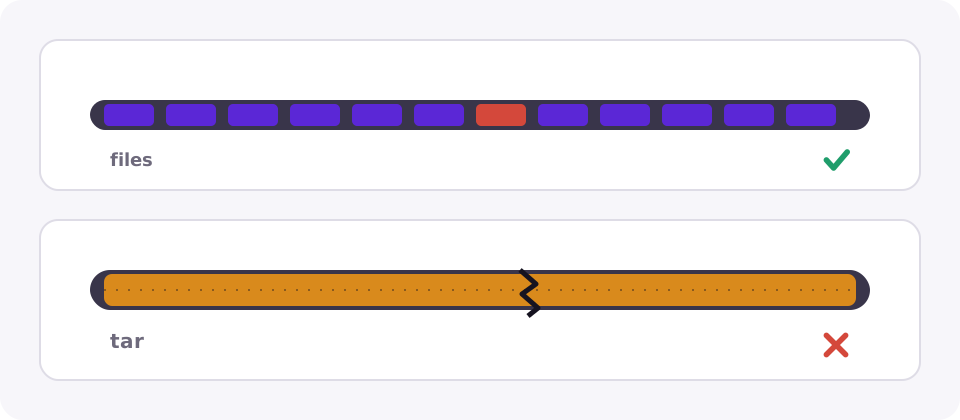
Loose files might be messy, but they’re resilient. If something gets corrupted, you lose a file—or a handful of them—not an entire project. With tar, corruption can cascade. One damaged section can take everything after it down with it.
As one perspective puts it bluntly: tar is great for organization, but worse for recoverability. And when you’re thinking long-term—years, maybe decades—that trade-off starts to feel dangerous.
This side isn’t optimizing for speed. It’s optimizing for survival.
And that shift in mindset changes everything. Suddenly, convenience feels secondary. What matters is how much you can recover when—not if—something fails.
The Hidden Enemy: Time
What makes this debate even more complicated is time—not just how long data lasts, but how long it takes to get it back.
Tape isn’t random access. It’s linear. That means if the file you need sits at the end of a massive archive, you’re in for a wait. Sometimes a long one.
One user puts it into perspective: pulling a file from the end of a large archive on a modern tape can take hours. On bigger tapes, it can stretch into half a day.
That’s where strategy creeps in. Some people compromise by splitting archives into smaller chunks—200GB to 500GB—so retrieval doesn’t become an all-day event.
Others accept the wait. “Just let the drive roar for three hours,” someone says, almost casually.
That’s the thing about tape. It forces you to rethink urgency.
The Middle Ground Nobody Fully Agrees On
Somewhere between these two extremes, a third approach emerges—messy, pragmatic, and very human.
Tar selectively. Bundle the chaotic parts—like tens of thousands of small EXR files—but leave everything else as loose files. Use checksums. Add indexes. Maybe even generate catalogs or recovery data alongside your archives.
It’s not as clean as “tar everything” or “tar nothing.” But it reflects how people actually work: balancing performance, safety, and sanity.
Even then, the details matter. Too many files can hit LTFS limits. Too few can slow down recovery. There’s no universal rule—just a series of trade-offs you learn through experience.
And that’s the uncomfortable truth: you don’t really know if your strategy works until years later.
This Isn’t About Format — It’s About Risk Tolerance
What’s striking is how emotional this technical debate becomes.
Some people want certainty. They lean toward verification, hashing, controlled archives. Others want flexibility. They prioritize partial recovery, even if it means slower performance or more complexity.
Neither side is wrong. They’re just optimizing for different fears.
One fears inefficiency and wasted time. The other fears irreversible loss.
And tape, by its nature, amplifies both. It’s not forgiving. It doesn’t adapt. It does exactly what you tell it—and nothing more.
The Quiet Reality of Long-Term Archiving
At some point, the conversation stops being about tar vs folders and starts being about trust.
Do you trust your archives to survive corruption? Do you trust your future self to remember how everything was structured? Do you trust that the tools you’re using today will still exist—or work—the same way years down the line?
That’s the weight behind a seemingly simple choice.
Because once those tapes are written and stored away, they become time capsules. And when you finally go back to them, maybe years later, you don’t get a second chance to rethink your approach.
You just get whatever you decided today.