When Hard Drives Get Too Expensive, People Get Creative
It usually starts with frustration. In this case, skyrocketing HDD prices pushed someone to abandon a traditional storage build and jump headfirst into LTO tape instead . On paper, it makes perfect sense. Tape offers massive capacity, long-term durability, and a lower cost per terabyte if you’re willing to deal with the quirks.
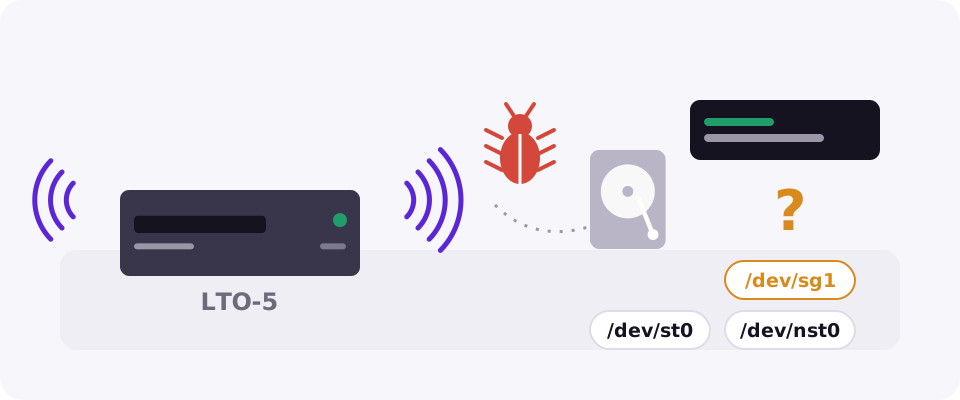
And at first, it works beautifully. A 13-year-old LTO-5 drive, still pushing 140MiB/s with 98% head life, feels like a victory. Backing up an entire data collection onto just 12 tapes in a week? That’s the kind of efficiency that makes you feel like you’ve cracked the system.
There’s even a weird charm to it. The mechanical sounds, the physicality of swapping tapes—it’s storage you can hear and touch. That alone makes it feel more “real” than spinning disks hidden in a server rack.
But that early success hides a deeper truth: tape doesn’t stay simple for long.
The Romance of Tape vs The Reality of Linux
Very quickly, the cracks start to show—not in the hardware, but in everything around it.
One issue sounds small at first: device files that don’t disappear after powering off the drive. It’s the kind of bug you might ignore on day one, but over time, it becomes part of a larger pattern. Tape setups aren’t clean. They’re messy, persistent, and sometimes confusing in ways that modern storage just isn’t.
Then there’s software. Tools that should work don’t. Diagnostics that function perfectly on Windows suddenly break on Debian. One user ends up passing hardware through a virtual machine just to get visibility into drive health.
That’s when the tone shifts. What started as a storage solution turns into a systems project.
Some people love that. Others hit this wall and immediately question their decision.
“Just Use LTFS” vs “Do It the UNIX Way”
The community splits fast when it comes to how you should actually use tape.
One camp pushes LTFS hard. Mount your tape like a filesystem, treat it like a giant removable drive, and avoid unnecessary complexity. “It was too frustrating otherwise,” one person admits, describing how LTFS made tape usable again.
Then there’s the purist approach: tarballs, manual workflows, full control. “I like it the UNIX way,” someone says, and you can almost hear the pride in that sentence.
These aren’t just technical preferences—they’re philosophies. One side values convenience and accessibility. The other values control and tradition.
And both sides quietly agree on one thing: there is no perfect way to use tape. Every method comes with trade-offs, and you only discover them after committing.
The Stuff That Actually Keeps People Up at Night
The real anxiety doesn’t come from setup or software. It comes from reliability—the kind that doesn’t show up until it’s too late.
One comment hits like a warning label: you really need at least two drives. Not for performance, but for validation. Because tape drives can fail in a very specific, very dangerous way—they can still read their own tapes while becoming incompatible with every other drive.
That’s the nightmare scenario. Your backups exist, but only inside a dying ecosystem.
Another voice adds to the unease: bad batches of tapes. Manufacturing issues that can misalign tracks and physically damage drives. Suddenly, buying cheap media doesn’t feel like a bargain anymore—it feels like a gamble.
And then there’s the subtle realization that testing matters just as much as backing up. “Make sure tapes written on one drive are readable on another.” It sounds obvious, until you realize most people never test that.
The Noise, The Heat, The Physical Reality
Tape isn’t quiet. It isn’t invisible. It demands space, airflow, and attention.
People worry about heat, especially with half-height drives. Do you need loud fans? Will it overheat during long sessions? The answers aren’t always clear, but experienced users often shrug it off: swap the fans, tweak the setup, it’ll probably be fine.
That “probably” is doing a lot of work.
Because unlike SSDs or cloud storage, tape makes you think about physical conditions. Dust, temperature, airflow—these aren’t edge cases. They’re part of the daily equation.
For some, that’s a dealbreaker. For others, it’s part of the appeal.
The Unexpected Cost of Going “Cheap”
What’s fascinating is how often this journey starts with saving money.
Skip expensive HDDs. Buy used enterprise gear. Build something powerful for less.
And yet, the deeper you go, the more that initial calculation starts to blur. You need more tapes. Maybe a second drive. Better cooling. More time to manage everything. More knowledge just to keep things running smoothly.
None of it feels outrageous on its own. But together, it adds up—not just financially, but mentally.
One perspective sees this as an investment. Another sees it as creeping complexity disguised as savings.
And then there’s a third take: it’s worth it if you enjoy the process. Not just the outcome, but the constant tinkering, learning, and occasional frustration.
This Was Never Just About Storage
At its core, this isn’t a story about tape. It’s about control.
Moving away from hard drives wasn’t just about cost—it was about building something independent. Something you understand, something you own.
That’s why people stick with it, even when it gets complicated. Even when the tools don’t work, the noise gets annoying, or the risks become clearer.
Because tape offers something modern storage often doesn’t: a sense of involvement.
You’re not just storing data. You’re managing it, shaping it, and sometimes fighting with it.
And for a certain kind of person, that’s not a downside.
It’s the whole point.